Industrial Infrastructure

Rainwater Harvesting System

Say “Rainwater Harvesting” and most people picture a barrel under a downpipe. An industrial system is different from conventional rainwater harvesting system. It’s plant infrastructure, designed the way you’d design any other utility: sized to the load, built so it can be serviced, and expected to run for years without anyone having to think about it.

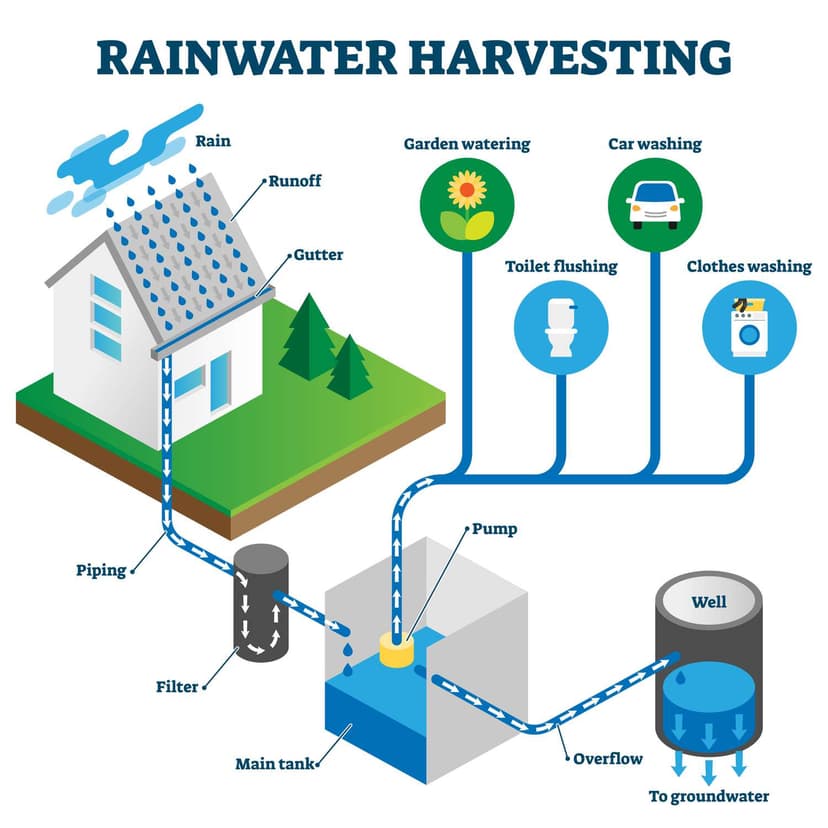
Strip it back and it does four jobs. It catches rain from your roofs and hard surfaces. It cleans that water. It stores it, or sends it down into the ground. And it delivers it to the parts of your plant that can use it. Each stage has its own equipment and its own ways of going wrong, which is why we design the whole chain together instead of handing you a list of parts and wishing you luck.

Nothing about it is off the shelf. Your roof, your drainage, your soil and the way your plant uses water are all different from the old rainwater harvesting systems, so we start with a survey, not a catalogue. The result is that our rainwater harvesting system cost almost zero maintenance and easy to install so your team doesn't have to nurse it every day.

Rainwater harvesting system

80%

Catchment efficiency

Kinetic Span

A quick sum

Here’s the arithmetic behind all of this. One millimetre of rainwater on one square metre of roof is one litre of water, and a well-kept catchment holds on to roughly 80% of it. Take an 8,000 square metre factory roof in a place that gets 750 mm of rain a year. That’s about 48 lakh litres a year, or around 480 tanker loads of 10,000 litres each, falling on a roof you already own.

Your real figure will depend on local rainfall records, roof materials and how the catchment is laid out, which is why the rainwater harvesting survey always comes first.

Annual potential

48 lakhlitres / year

8,000

square metres roof

750 mm

annual rainfall

480

tanker loads

80%
Save water

Built as one system

Technical Features

Here’s what goes into a rainwater harvesting system, in the order the water meets it.

01

Catchment and conveyance

Industrial roofs are big, often thousands of square metres, and a monsoon downpour sends a lot of water into the gutters very quickly. We lay out guttering and piping to suit your particular roof, sized to carry the flow instead of spilling over the edge. Every litre that makes it into the system is a litre your roof has earned.

02

Filtration

Multi-stage filters take out leaves, dust and sediment. Ahead of them sits a first-flush diverter, which throws away the first runoff of each storm. That first rush carries most of the grime that settled on the roof since the last rain, so removing it makes a real difference to water quality. Cleaner water going in means less maintenance and a longer life for everything downstream.

03

Storage tank

High-capacity tanks in food-grade FRP or polymer, or in reinforced concrete, above ground or below. Every tank has an overflow, so an extreme storm has somewhere safe to go, and level sensors, so you can see what’s inside without climbing up to look.

04

Treatment and controls

For non-potable reuse, UV disinfection or chlorination can be added where the application calls for it. Pumps and valves run on smart sensors that send water where it’s needed and stop anything overflowing, so nobody has to babysit the system.

05

Backflow protection

Critical valves stop harvested water from flowing back into the municipal supply. It’s a small part with an important job: it protects the public water and keeps your system on the right side of the utility.

06

Monitoring

Flow meters, level indicators and data loggers track how the system performs. Your operations team can see at a glance whether everything is working, and your sustainability team gets real figures for litres collected and reused, not estimates.

Why it matters

Industry Benefits

01

Lower water costs.

Harvested rainwater offsets borewell and tanker water, so you spend less on utility charges, less on extraction and less on tankers that arrive when they feel like it. The savings start with the first monsoon after commissioning and repeat every year, which is how a system earns its keep.

02

Compliance and sustainability.

A working system helps you meet regulatory requirements such as CGWA recharge conditions and pollution-control norms. It also gives you something concrete to point to in ESG and circular-economy reporting: water collected, reused and returned to the ground, with data behind it.

03

Operational resilience.

When supply gets tight, stored rainwater is your emergency backup. Critical processes like cooling and cleaning can keep running while others wait for a tanker. It won’t cover everything, but having a reserve you control changes how a dry spell feels.

04

A lighter footprint.

Capturing runoff reduces the water rushing across your site, which means less flooding and erosion on your own premises. And water that goes into the ground or into use is water that doesn’t strain the public system or the local ecosystem.

Where the water goes

Applications

Rainwater Harvesting is most useful where the water doesn’t need to be drinking quality, which covers a lot of an industrial site.

01

Process water.

Cooling tower makeup, boiler feed and equipment washing are some of the most common uses, and often the thirstiest. With the right treatment for each, rainwater can take a real bite out of that demand.

02

Sanitation.

Flushing toilets and cleaning floors don’t need drinking-quality water, yet at many sites that’s exactly what they use. Rainwater is a natural fit, and so is watering landscaping.

03

Site runoff control.

Parking areas, yards and other hard surfaces shed a great deal of water in a storm. We can capture it for reuse, or direct it to percolate into the ground, instead of leaving it to overwhelm the drains.

04

Amenity and green spaces.

Green belts, gardens and landscape features on a campus are an easy first use for stored rainwater, and a visible one. Staff and visitors can see exactly where the water comes from.

From survey to operation

Installation

Installation starts with the site survey and moves through excavation, if you’re having an underground tank, and the plumbing connections. We coordinate with your civil contractors on things like concrete footings and with your electrical team on pumps and controls, so nobody is surprised halfway through. Our engineers and certified contractors do the work, and we test every connection before we call it done.

Site survey → Excavation → Base Preparation → Laying of Geotextile → Installation Tank → Back Filling → Filter Connection → Testing

Keep it running

Maintenance

A well-designed rainwater harvesting system needs less looking after than you’d think, but it isn’t nothing. Here’s what to expect:

01

Gutters and filters: inspect and clean at least once a year, and clear debris screens and first-flush devices after storms.

02

Storage tanks: remove sediment every three to five years, with periodic flushing in between.

03

Pumps and UV units: periodic checks. Pumps typically last somewhere between two and ten years, depending on how hard they work and how well they’re cared for.

04

Controls and electronics: these typically carry five to ten year warranties and are replaced when needed.

If you’d rather not add this to your team’s to-do list, we offer maintenance contracts, so someone is always keeping an eye on it for you.

Project delivery

Timeline

Every project is different, but this is what a typical medium-sized industrial facility for rainwater harvesting system looks like:

01

Site survey and design:

1 week

02

Permitting and procurement:

1 to 2 weeks, much of it waiting for tank fabrication

03

Construction and installation:

2 to 3 weeks, covering the tank, piping and electrical work

04

Commissioning:

1 week, testing the pumps and water quality

Add those up and you’re looking at roughly six to eight weeks from first visit to a working system. Larger sites take longer, smaller ones less. We’ll give you a realistic schedule once we’ve seen your site, and we plan it around your production calendar, not against it.

Common questions

FAQs

01How much rainwater can we collect?+

It depends on your roof area, your rainfall and how well the catchment is set up. The basic sum is roof area in square metres, times annual rainfall in millimetres, times about 0.8, which gives litres a year. A full calculation uses your catchment area, rainfall records and efficiency factors specific to your roof, and we’ll run it during the survey.

02Do harvesting systems reduce flood risk?+

Yes. By capturing runoff and sending it to storage or recharge, a system cuts the amount of stormwater leaving your site. It has limits, though: a tank of finite size can fill up during an extreme storm, which is why every system gets a proper overflow route.

03Is the water safe to touch or use?+

With proper filtration, rainwater is generally fine for non-potable uses such as irrigation and flushing. For any potable use, additional disinfection with UV or chlorine is needed, and the water has to meet local standards. If that’s what you have in mind, tell us early so we can design for it.

04What maintenance is required?+

Clean debris screens and first-flush devices after storms, flush the tanks from time to time and have the gutters and filters inspected every year. If you’d rather hand that over, Kinetic Span offers maintenance contracts for peace of mind.

05Do we need a recharge pit as well as a tank?+

Not always, but the two work well together. Tanks hold water for reuse, while recharge pits take care of the surplus and help meet recharge requirements. We’ll recommend the right mix after the survey.

06Should we choose a modular system or a custom one?+

If you’re short on time, short on space or expect to grow, a modular system can be a great fit. For large or complicated sites, a fully custom design usually makes more sense. We’ll tell you honestly which one suits you.

Start with your site

Let’s Look at Your Roof

Whether you’re starting from scratch or comparing quotes, we’d like to hear about your site. Contact Us for a free consultation, or see everything we do on the Services Overview page.